Yogurt Manufacturing Plant Setup: Equipment and Cost Planning Guide
Issacindustry
<!DOCTYPE html>
Yogurt Manufacturing Plant Setup: Equipment and Cost Planning Guide 2026
If you are planning a yogurt manufacturing plant in 2026, you are making one of the highest-leverage decisions in the dairy processing sector. The global yogurt market is valued at over $65 billion and is projected to grow at 5.8% CAGR through 2030. The growth drivers—functional probiotics, high-protein formats, premium artisanal positioning—favor new entrants who can configure their plants for the specific product niches the established players are too large to serve efficiently.
But most entrepreneurs planning a yogurt manufacturing plant setup make the same mistake: they treat the equipment purchase as the starting point. It should be the last decision. This guide walks you through the full investment planning sequence—market-driven product configuration first, then equipment engineering, then supplier selection—so every dollar you spend is justified by revenue, not just spec sheets.
Section 1: What Type of Yogurt Production Line Do You Need?
Before looking at equipment costs, you need to decide which type of yogurt line matches your target market and product vision. The configuration choice determines everything downstream.
Four Yogurt Line Types — Which One Fits Your Market?
Stirred Yogurt Line (2,000–15,000 L/day)
Stirred yogurt is the dominant format globally and the most forgiving for new plant operators. Equipment cost: $180,000–$450,000 from Chinese suppliers for a 5,000 L/day line.
Set Yogurt Line (500–8,000 L/day)
The product ferments in the cup, producing a firm gel texture. Higher retail prices (typically 30–50% above stirred yogurt) but lower line speeds and higher packaging costs.
Drinking Yogurt / Fermented Milk Line (3,000–20,000 L/day)
Growing fastest in Southeast Asia and Latin America. Equipment cost: $250,000–$600,000 for a turnkey 5,000 L/day line due to filling machine premium.
Artisanal / Farmstead Yogurt Line (200–2,000 L/day)
Batch pasteurization, manual filling, direct-to-consumer sales. Equipment can start as low as $15,000–$40,000.
The Critical First Question: Fresh or Shelf-Stable?
Refrigerated yogurt has a 14–21 day shelf life at 0–4°C. UHT yogurt has a 6–9 month shelf life at ambient temperature. Most new plants target the refrigerated segment first—it has lower entry cost and allows product differentiation.
Section 2: Complete Yogurt Plant Equipment List
1. Milk Reception and Pre-Treatment
Balance tank and raw milk pump: Raw milk arrives at 2–4°C. The balance tank provides gravity-fed supply while milk continues arriving. Inline filter removes physical impurities. Budget: $2,000–$8,000.
2. Standardization and Homogenization
Fat standardization system: Adjusts fat content to match target yogurt specification. Budget: $3,000–$12,000.
Homogenizer — non-negotiable for most formats: Homogenization at 150–200 bar prevents whey separation. For stirred and drinking yogurt, it is essentially mandatory. Two-stage homogenizers (200/50 bar) produce superior texture. Budget: $12,000–$40,000.
3. Pasteurization — The Heat Treatment Core
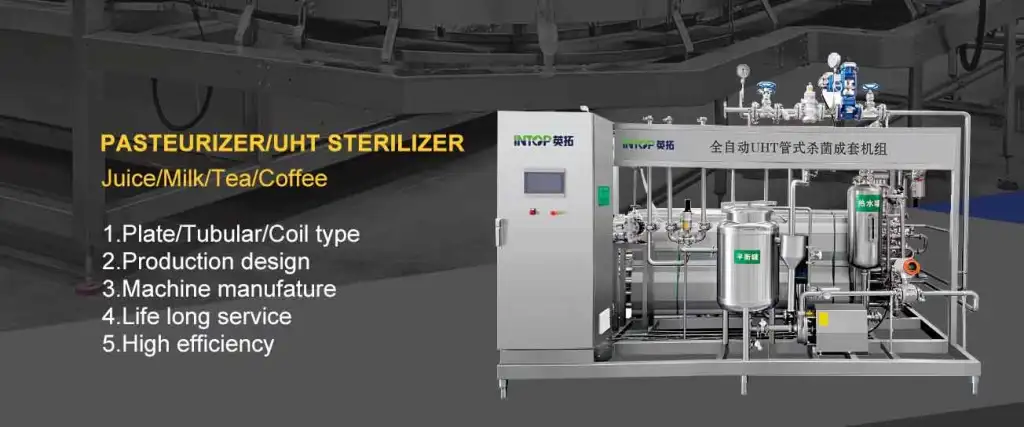
HTST Pasteurizer (90–95°C for 15–30 seconds): The pasteurizer heats milk to fermentation-ready temperature. Plate heat exchangers are most common at this scale. Budget: $20,000–$70,000. Higher regeneration efficiency reduces energy cost per liter over equipment life.
4. Fermentation — Where Your Product Is Made
Culture preparation tank (optional but recommended): For plants developing proprietary culture blends, a dedicated culture preparation tank is essential. Budget: $3,000–$10,000.
Fermentation tanks — your most critical equipment investment: Insulated, jacketed tanks with precise temperature control (40–45°C ± 0.5°C). Fermentation time: 4–8 hours depending on culture and target pH (4.4–4.6). A 5,000 L/day plant with 6-hour fermentation needs minimum 2×2,500–3,000L tanks for staggered production. Budget: $15,000–$50,000 per tank.
5. Cooling and Aging
Cooling tank: Product must be cooled to 4°C within 30 minutes after fermentation. Glycol-jacketed tanks are standard. For set yogurt, product goes directly to filling. For stirred yogurt, gentle agitation prevents gel formation. Budget: $5,000–$20,000.
6. Filling and Packaging
Cup filler (80g–500g): Rotary cup fillers for medium-to-large scale: $60,000–$200,000. Linear cup fillers for smaller scale: $20,000–$60,000. Line speed: 3,000–10,000 cups per hour depending on size and automation.
Bottle filler: For drinking yogurt and stirred yogurt in bottle format. Similar price range.
Paper cup with aluminum lid: Premium positioning, higher packaging cost but better barrier properties. $40,000–$120,000.
7. CIP System
Clean-In-Place system for sanitation between every production batch. CIP turnaround time directly affects effective production capacity. Budget: $10,000–$40,000.
8. Quality Control Laboratory
Minimum: incubator, pH meter, acidity titrator, weighing equipment. Budget: $5,000–$20,000. Not optional—regulators and retail buyers both require it.
Section 3: Yogurt Manufacturing Plant Setup Cost — 2026 Pricing by Capacity
| Daily Capacity | Configuration | Chinese Supplier Equipment Cost | All-In Turnkey |
|---|---|---|---|
| 1,000 L/day | Batch pasteurizer, 2 fermentation tanks, semi-auto cup filler | $45,000 – $80,000 | $60,000 – $120,000 |
| 3,000 L/day | HTST pasteurizer, 3 fermentation tanks, automatic cup filler | $120,000 – $200,000 | $155,000 – $290,000 |
| 5,000 L/day | HTST + homogenizer, 4 fermentation tanks, rotary cup filler | $180,000 – $320,000 | $235,000 – $460,000 |
| 10,000 L/day | Dual pasteurizer or single large, 6 fermentation tanks, high-speed filler | $300,000 – $500,000 | $390,000 – $725,000 |
| 20,000 L/day | Continuous processing, 8+ fermentation tanks, dual-line filler | $550,000 – $850,000 | $715,000 – $1,235,000 |
Equipment purchase price typically represents 55–70% of total project investment. Installation, electrical, piping, instrumentation, civil works, and commissioning add 30–45% above equipment price.
Total yogurt manufacturing plant setup cost for 5,000 L/day: approximately $350,000–$650,000 all-in.
Section 4: How to Configure a Yogurt Line for Profitability
Capacity sizing: Size your first line for conservative year-1 sales forecast at 85% utilization. Add 20% buffer. Leave floor space for a second line when revenue justifies deployment.
Product mix flexibility: If your 3-year plan includes multiple formats, configure fermentation tanks and filling equipment upfront. The incremental cost at purchase time is far lower than modifying later.
The fermentation tank bottleneck: Most new plants underestimate downstream equipment needed to match fermentation output. Design filling and cooling capacity to match fermentation output in the same shift window.
Section 5: Project Timeline
- Month 1–2: Feasibility, site selection, supplier evaluation and contract signing
- Month 3–5: Equipment manufacturing (Chinese: 3–5 months; European: 6–10 months)
- Month 6–7: Site preparation, civil works, equipment delivery and installation
- Month 7–8: Installation supervision, CIP commissioning, trial production
- Month 8–9: Regulatory inspection, first commercial batch, operational handover
Total timeline from contract to commercial production: 7–10 months for Chinese turnkey suppliers.
Section 6: Choosing a Yogurt Equipment Supplier — Questions to Ask
- Can you provide references from two plants running the same yogurt format for at least two years?
- What is your CIP validation documentation for yogurt fermentation tanks?
- Do you provide process flow diagrams, P&ID drawings, and operator training materials in my local language?
- What is your remote diagnostic capability?
- What are your fermentation tank temperature control specifications (±0.5°C across full volume)?
- Do you provide recipe development support?
Section 7: FAQ
Q: What is the minimum viable capacity for retail distribution?
3,000–5,000 L/day for mainstream retail. Below 2,000 L/day, per-liter overhead makes competitive pricing very difficult except in premium niches.
Q: What is the difference between set and stirred yogurt lines?
Set yogurt ferments in the cup (slower, higher retail price). Stirred yogurt ferments in tanks, is cooled and stirred, then filled (faster, creamier texture).
Q: How long does yogurt fermentation take?
4–8 hours at 40–45°C to reach pH 4.4–4.6, depending on culture strain and desired final acidity.
Q: Can one line produce multiple product types?
Yes, with sufficient fermentation capacity, interchangeable filling formats, and programmable CIP. Product changeovers require 2–4 hours of CIP—schedule accordingly.
Q: What certifications does a yogurt plant need?
ISO 22000 or FSSC 22000 food safety certification, HACCP documentation, national dairy standards compliance (China: GB 19302; EU: Regulation (EC) 853/2004).
Q: Should I buy a used yogurt line?
Only if line was operating within past 12 months with complete maintenance records and budget of 25–35% of purchase price for reinstallation and debugging. For most new entrants, a turnkey Chinese supplier package offers better value.
Q: How much to add drinking yogurt capability to an existing line?
Incremental investment: $100,000–$250,000 depending on format—primarily the aseptic filling system.
Ready to Configure Your Yogurt Manufacturing Plant?
ISSAC INDUSTRY provides turnkey yogurt production line solutions with complete process engineering documentation, on-site commissioning, and recipe development support. Tell us your target capacity, preferred yogurt format, and market destination—and we will send a preliminary configuration and budget estimate within 48 hours.
Get a free yogurt manufacturing plant setup estimate → Contact us with your production target, product format, and investment parameters.
Related equipment: Yogurt Production Line | Fermentation Tank Series | HTST Pasteurizer | Homogenizer Series