Beverage Turnkey Project Checklist: Don't Start Your Plant Without This
Issacindustry
Beverage Turnkey Project Checklist: Everything You Need Before Signing
Rushing into a beverage turnkey project without a structured checklist is one of the costliest mistakes a food and beverage entrepreneur can make. Hidden infrastructure gaps, ambiguous equipment specifications, and missed regulatory deadlines have derailed countless beverage factory projects — often after contracts are signed and deposits paid. This checklist walks you through every phase of a beverage manufacturing turnkey project, from initial site assessment to post-installation commissioning, so you enter negotiations informed and leave nothing to chance.
What Exactly Is a Beverage Turnkey Project? Scope and Definitions
A beverage turnkey project means a single contractor delivers a fully operational beverage production facility — all equipment, installation, pipeline routing, electrical hookups, and commissioning included — under one contract. You receive keys, turn them, and start producing.
The alternative is managing multiple vendors yourself: one for the water treatment system, another for the mixing tank line, a third for the bottling equipment, a fourth for installation. Each interface gap becomes your problem. Turnkey eliminates that coordination burden, but it concentrates risk — which is exactly why a rigorous pre-commitment checklist matters so much.
Common beverage formats covered under turnkey contracts include:
- Carbonated soft drinks (CSD) production lines
- Juice processing and packaging (NFC, from concentrate, SSE)
- Pure water and bottled drinking water plants
- Plant-based beverages (soy, oat, almond milk lines)
- RTD tea and coffee filling systems
If your project involves more than one of these, confirm the contractor's experience with multi-format facilities before proceeding.
Pre-Commitment Checklist: Site, Utilities, and Infrastructure
Before you sign anything, the physical site must be evaluated honestly. A contractor who promises to "figure it out" on site is passing risk to you.
Site Readiness Assessment
- Land use permit and environmental impact assessment (EIA) approval in hand
- Soil bearing capacity report for heavy equipment foundations
- Flood risk assessment for the proposed location
- Proximity to raw water sources and wastewater discharge points
- Distance to target distribution markets (affects freight cost competitiveness)
Utility Requirements by Beverage Type
Each beverage format has non-negotiable utility demands. Know these before your site selection is final:
- Processed water: RO water system capacity must match peak production volume (e.g., a 5,000 BPH juice line may need 10,000 L/hr of purified water)
- Electrical load: A complete carbonated beverage line with CO2 carbonation, electric hoist, and conveyor system can require 200-500 kW dedicated supply
- Steam: UHT treatment and hot filling lines require steam boilers (typically 500-2,000 kg/hr at 8-10 bar)
- Compressed air: Pneumatic valves and instrumentation need oil-free compressed air (typically 6-8 bar, 500-2,000 Nm3/hr)
- Cold water: Hot-fill lines need cooling systems for bottle gradual cooling; pasteurization tunnels require dedicated glycol chilling
Infrastructure Red Flags to Watch
Contractors sometimes underbid by assuming ideal site conditions. Verify these before contract signing:
- Grid power availability and guaranteed capacity from the local utility
- Municipal water pressure and quality report (hardness, TDS, microbial load)
- Wastewater treatment plant capacity and discharge permit feasibility
- Gas (natural gas or LPG) pipeline access for steam boilers
Equipment Specification Checklist for Beverage Production Lines
Equipment is where budget decisions have the longest consequences. Vague specifications create room for contractor substitution — inferior pumps, under-sized heat exchangers, or automation systems that can't integrate with your future ERP.
Core Equipment Modules: What Must Be Specified
1. Water Treatment System
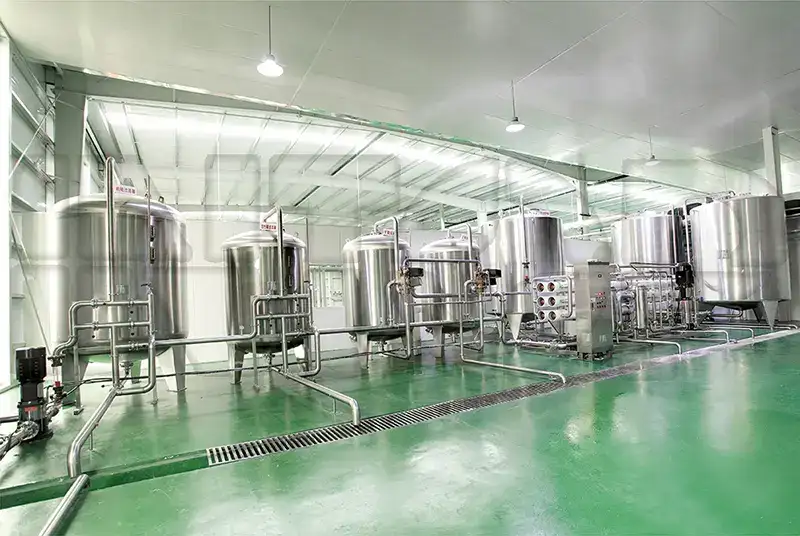
- Pre-treatment: multimedia filter, activated carbon filter, softening system
- RO membrane specs: capacity (L/hr), rejection rate (≥95%), salt rejection percentage
- UV sterilization and ozone disinfection stage inclusion
- Tank material: 304 stainless steel minimum for product contact
2. Mixing and Dissolution Systems
- Blend tank capacity matching your batch size (typically 2,000-10,000 L)
- Agitator motor power (kW) and impeller design for your specific beverage viscosity
- Sugar dissolution system: lump breaker or high-shear mixer specification
- Carbonation system (for CSD): CO2 purity requirement (≥99.9%), carbonation pump pressure
3. Heat Treatment Equipment
- UHT system: direct (steam injection) vs indirect (plate heat exchanger) — each has different taste impact and operating cost
- Pasteurization tunnel: surface temperature vs core temperature hold time (typical: 20 min at 72°C for HTST)
- Hot fill system: temperature setpoint (typically 88-95°C) and hold time
- Cooling section: gradient cooling from fill temperature to 25°C ambient
4. Filling and Packaging Line
- Filling machine type: gravity, pressure, volumetric, or flow meter — selection depends on product carbonation and viscosity
- Container format: PET bottle, glass bottle, aluminum can, carton, pouch — each requires different filling technology
- Throughput: BPH (bottles per hour) rated vs effective (accounting for changeover and stoppages, effective throughput is typically 75-85% of rated)
- Sealing technology: crown cork, screw cap, roll-on pilfer-proof (ROPP), snap cap
5. Quality Control Instrumentation
- Inline turbidity meter for fill accuracy monitoring
- Metal detector or X-ray inspection for packaged product
- CO2 content analyzer for carbonated beverages
- BRIX refractometer for sugar concentration monitoring
- pH meter with automatic dosing control for acid adjustment
Automation and Control Specification
A beverage line without a defined automation scope becomes unmanageable:
- PLC brand and model: Siemens S7, Mitsubishi, or Schneider are industry standard
- HMI interface: touchscreen control panel with recipe management for different beverage SKUs
- SCADA connectivity: MODBUS, PROFINET, or EtherNet/IP protocol support for ERP integration
- Alarm and historian logging: production data logging for quality traceability
- Remote access capability for vendor troubleshooting (with security protocol defined)
Equipment Red Flags That Signal Cost Cutting
When reviewing a contractor's equipment list, these are warning signs:
- Pump specifications without NPSH (Net Positive Suction Head) calculation — risks cavitation and premature failure
- Heat exchanger quoted without log mean temperature difference (LMTD) calculation — indicates copy-paste pricing
- Tanks without sanitary design certifications (3-A Sanitary Standards or equivalent)
- Filling machine speed quoted without specifying container weight and fill temperature variables
Documentation and Compliance Checklist for Beverage Manufacturing
In regulated markets — EU, US FDA, Gulf GSO, East African Standards — documentation isn't optional. It is the difference between a product that clears customs and one that gets rejected or recalled.
Pre-Operation Permits and Licenses
- Food production license from the relevant national food safety authority
- Business operating license with beverage manufacturing scope
- Environmental discharge permit for wastewater
- Water usage permit if drawing from private boreholes or municipal supply above threshold
- Boiler operation permit (for steam systems above regulated pressure thresholds)
- Fire safety certification for the production facility
Equipment Documentation Required
- CE / UL / GSO conformity certificates for imported equipment
- Material certificates (MTR/Mill Test Reports) for all product-contact stainless steel
- Welding procedure specifications (WPS) and welder qualification records for pressure vessels
- Instrument calibration certificates for all measurement devices
- 3-A sanitary certificate or equivalent for tanks, pipes, and fittings
- FDA food contact material compliance declaration (21 CFR parts 174-180)
Food Safety Management Documentation
- HACCP (Hazard Analysis Critical Control Points) plan specific to your beverage product
- ISO 22000 food safety management system certificate (often required for export markets)
- Traceability procedure: from raw material batch to finished case — minimum 30-day record retention
- Sanitation standard operating procedures (SSOPs) for CIP (Clean-in-Place) and COP (Clean-out-of-Place)
- Allergen management plan covering the full production line
Labeling Compliance for Target Markets
Different markets have different labeling rules. Your turnkey contractor should flag this, but verify yourself:
- Nutritional information panel format per destination market regulation
- Allergen declaration requirements (EU uses Annex III, US uses FALCPA)
- Country of origin marking
- Language requirements: Arabic (with RTL layout) for GCC markets, French for West Africa
- Barcode format (EAN-13, UPC-A) and GS1 company prefix allocation
Post-Installation: Commissioning, Training, and Support Checklist
Getting equipment delivered on time is only half the battle. The gap between "equipment installed" and "equipment producing sellable product" is where most projects blow their timeline and budget.
Commissioning Phase Deliverables
- Empty run (dry run): mechanical and electrical verification without product
- Water run: sanitation and leak testing with purified water
- Trial runs with actual product: minimum 3 consecutive batches at target throughput
- Fill accuracy test: minimum 30 samples across fill range, measured against target volume
- Sealing integrity test: burst test for PET bottles, torque test for screw caps
- Cleaning validation (CIP protocol verification): ATP swabs and microbial rinse tests
- Performance qualification (PQ): 72-hour continuous run at rated capacity to validate sustained performance
Performance指标 (KPIs) to Define Before Commissioning
- Actual production output as % of rated capacity (target: ≥85% sustained)
- Product yield: % of input raw material that becomes sellable product
- Changeover time: time to switch between different bottle sizes or flavor SKUs
- Downtime rate: unplanned stoppages per shift (target: ≤3%)
- First-pass yield: product that passes all quality checks without rework
Operator Training Requirements
A well-commissioned line fails if operators aren't trained. Your contract should specify:
- On-site training for minimum 2 weeks during commissioning, covering all shifts
- Written operating procedures (SOPs) for every major equipment module
- Preventive maintenance schedule and illustrated maintenance manual
- Troubleshooting guide for common fault conditions (jam clearance, sensor faults, valve failures)
- Spare parts starter kit: minimum 6-month consumption of wear parts (seals, bearings, filters)
After-Sales Support Terms to Negotiate
- Warranty period: minimum 12 months from commissioning sign-off, not from shipment
- Response time commitment: remote support within 24 hours, on-site within 72 hours
- Software update policy for PLC and HMI systems during warranty
- Annual preventive maintenance visit option with cost defined upfront
- Spare parts pricing list locked in at contract — not subject to post-contract revision
FAQ: Beverage Turnkey Project Checklist
Q: What is the typical timeline for a beverage turnkey project from contract to first production?
A: For a small-scale beverage plant (2,000-5,000 BPH), the typical timeline is 6-9 months from contract signing to first sellable product. Medium-scale projects (10,000-20,000 BPH) typically take 10-14 months. Large-scale facilities (30,000+ BPH) can require 18-24 months. The site preparation and permitting phase is often the longest variable outside the contractor's control.
Q: How much does a beverage turnkey project cost?
A: Turnkey project costs vary widely by capacity and automation level. A basic 3,000 BPH water bottling line (PET) turnkey project typically starts from USD 180,000-350,000. A mid-range 10,000 BPH carbonated soft drink line with UHT treatment typically ranges USD 500,000-900,000. High-speed lines (20,000+ BPH) with full automation can exceed USD 1.5 million. Always request the cost breakdown by module — this is where budget surprises hide.
Q: Should I choose a local or international contractor for a beverage turnkey project?
A: International contractors (Tetra Pak, Krones, Sidel) offer proven technology and global warranty networks but at 2-3x the cost. Chinese manufacturers offer significant cost advantages with increasingly competitive quality standards. The right choice depends on your market entry requirements: if you need CE or FDA compliance documentation and your target markets require it, confirm your contractor's track record with those specific markets before signing.
Q: How do I verify a beverage equipment contractor's quality claims?
A: Request the following before contract: (1) At least 3 reference plants of similar capacity in your target region, with working contact details. (2) Video call or site visit to a running reference installation. (3) Sub-supplier list for critical components (pumps, valves, PLC) — brand names tell you the quality tier. (4) Fabrication workshop photos or video showing welding standards and quality control procedures.
Q: What are the most common causes of beverage turnkey project delays?
A: The top three causes are: (1) Site infrastructure not ready when equipment arrives — contractor installs nothing while waiting for you to fix utilities (you pay for idle time). (2) Equipment customization requests added after contract — change orders add 4-12 weeks. (3) Third-party testing and certification delays — labs for GSO, EU, or FDA compliance testing can take 6-10 weeks and are often out of the contractor's control. Build these buffers into your project schedule from day one.
Start Your Beverage Project the Right Way
A beverage turnkey project is a major capital commitment. The buyers who avoid costly surprises are the ones who walk into contract negotiations with this checklist already worked through. Every item you verify before signing is a risk you've transferred away from yourself and onto the contractor — where it belongs.
Ready to move forward with your beverage production line? Get a detailed project assessment and equipment quote tailored to your capacity and target market.
→ Request Your Free Beverage Project Quote
Beverage Production Line Equipment | Water Treatment System | Turnkey Plant Solutions