Pasteurized Milk Production Line Investment: Cost and ROI Analysis 2026
Issacindustry
Pasteurized Milk Production Line Investment 2026: Cost and ROI Analysis
For most new dairy entrepreneurs, the first line they consider is a pasteurized milk line—not because they have studied the alternatives, but because it feels like the intuitive choice. Fresh milk, familiar product, straightforward process. And for many markets, it is the right choice. But not for all of them, and the ones who discover this after signing equipment contracts tend to write very expensive post-mortems.
This guide is a financial and operational framework for pasteurized milk production line investment in 2026. It covers what a pasteurized line actually costs, when it is the right choice versus UHT or ESL lines, how to size it for profitability, and what the realistic return-on-investment timeline looks like for different scales of operation.
What Is a Pasteurized Milk Production Line?
A pasteurized milk production line processes raw milk using HTST (High-Temperature Short Time) pasteurization—heating milk to 72–85°C for 15–20 seconds—to destroy vegetative bacteria while preserving the fresh milk flavor and nutritional profile. The finished product must be kept refrigerated throughout distribution, with a shelf life of 7–14 days depending on packaging and cold chain quality.
Comparing Pasteurization, UHT, and Fresh Milk: Which Line Should You Choose?
| Process | Temperature | Shelf Life | Cold Chain | Equipment Cost | Best For |
|---|---|---|---|---|---|
| Pasteurized (HTST) | 72–85°C / 15–20 sec | 7–14 days | Required throughout | $150,000–$1.2M | Local/regional fresh milk, domestic markets with reliable refrigeration |
| ESL (Extended Shelf Life) | 90–130°C / 1–4 sec | 21–45 days | Required, less stringent | $200,000–$800,000 | Regional distribution with moderate cold chain, specialty fresh products |
| UHT | 137–145°C / 3–5 sec | 6–9 months | Not required (shelf stable) | $400,000–$2.2M | Export, hot climates, long-distance distribution, institutional buyers |
Equipment Components in a Pasteurized Milk Production Line
1. Raw Milk Reception Station
Raw milk from farms or dairy collectors arrives at 2–4°C. The reception station includes balance tank, plate heat exchanger for pre-cooling, milk pump, inline filter, and sampling station for quality testing. Reception quality determines everything downstream—if raw milk arrives with high bacterial load, finished product quality will be marginal regardless of processing precision.
2. Raw Milk Storage Silo
Insulated storage silo sized for 12–24 hours of processing. For small-scale plants (under 5,000 L/day), a single 10,000–15,000 L silo is sufficient. For larger plants, dual silos allow continuous processing during milk tanker delivery intervals.
3. Separator and Standardizer
Centrifugal separator operating at 8,000–10,000 RPM splits whole milk into skim milk and cream. Standardizer adjusts fat content to product specification (3.2% for full-fat, 1.5% for semi-skimmed). Separator sizing: 10,000–60,000 L/hr throughput range.
4. Homogenizer
Unhomogenized pasteurized milk separates within 24–48 hours in the package. Homogenizer operating at 150–200 bar prevents this. Skipping homogenization is acceptable for opaque paper cartons but retail-ready bottles and transparent packaging require homogenization or the product looks unacceptable on shelf.
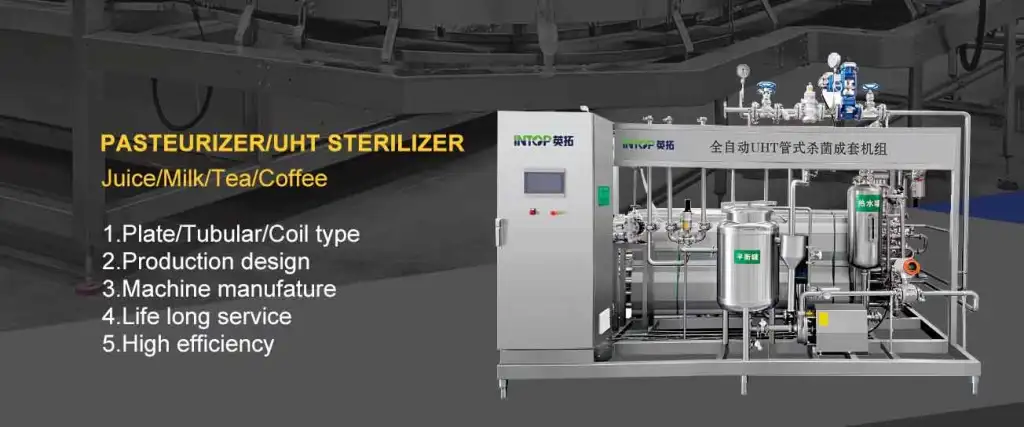
5. HTST Pasteurizer
The core of the line. Plate heat exchanger heats milk to 72–85°C for 15–20 seconds in the holding tube, then rapidly cools to 4°C. Key specifications: flow rate (determines throughput), temperature accuracy (must hold within ±0.5°C of target), and recovery time after CIP cycles.
6. Cooling Tank and Storage Silo
Post-pasteurization insulated cooling tank with glycol-jacket cooling brings product to 4°C. Tanks must hold product at 4°C for up to 12 hours for plants that process in early morning and fill in the evening.
7. Filling and Packaging Machine
Common formats: paper gable-top cartons (500ml, 1L), HDPE plastic bottles, glass bottles, pillow pouches. Paper cartons are most common for retail; plastic bottles offer lower tooling cost for custom shapes.
8. CIP System
Clean-in-place system for sanitation between batches. Pasteurized CIP turnaround is faster than UHT—typically 1.5–2.5 hours per batch versus 3–5 hours for a UHT line. Budget $20,000–$60,000 for a pasteurized-grade CIP system.
Investment Cost by Scale: What Pasteurized Lines Actually Cost in 2026
| Scale | Daily Capacity | Chinese Supplier (USD) | European Supplier (USD) | Best For |
|---|---|---|---|---|
| Micro | 500–2,000 L/day | $30,000 – $80,000 | $80,000 – $180,000 | Artisanal, local direct-sale only |
| Small-scale | 2,000–5,000 L/day | $80,000 – $200,000 | $200,000 – $450,000 | Regional retail, hospitality sector |
| Medium-scale | 5,000–15,000 L/day | $200,000 – $500,000 | $500,000 – $1,100,000 | City-level supply, provincial retail chains |
| Large-scale | 15,000–30,000 L/day | $500,000 – $900,000 | $1,100,000 – $2,000,000 | National retail supply, food service |
| Industrial | 30,000–50,000+ L/day | $900,000 – $1,500,000 | $2,000,000 – $3,500,000 | Export, major retail chains, institutional contracts |
Equipment cost covers 60–75% of total project cost. Installation, civil works, utilities, and commissioning add 25–40% above equipment cost. All-in: $500,000 equipment becomes $650,000–$750,000 complete installed project.
Profitability Analysis: When Does a Pasteurized Line Make Financial Sense?
The economics of pasteurized milk are volume-driven. Unlike UHT, where packaging material cost dominates, pasteurized lines have higher per-liter operating costs in labor and cold chain logistics but lower packaging costs per unit.
Revenue Per Liter
- Developing markets (sub-Saharan Africa, South Asia, Southeast Asia): $0.60–$1.20 per liter
- Middle-income markets (Latin America, Eastern Europe): $0.90–$1.80 per liter
- Developed markets (EU, North America): $1.20–$2.00 per liter
- Organic or premium pasteurized milk: $2.50–$5.00 per liter
Cost Per Liter (Approximate)
- Raw milk input: 70–85% of total production cost
- Packaging: $0.02–$0.08 per liter depending on format
- Labor: $0.02–$0.08 per liter depending on automation level
- Utilities: $0.01–$0.04 per liter
- Maintenance and quality control: $0.01–$0.03 per liter
- Cold chain logistics: $0.05–$0.20 per liter depending on distance
ROI Framework by Scale
Micro-scale (500–2,000 L/day): Viable only in premium niche markets. Best case: $1,000–$3,000 net operating profit per day. Payback: 3–6 years.
Small-scale (2,000–5,000 L/day): Viable for regional distribution in secondary cities. Breakeven requires 70–80% utilization in year 1. Net margin: 8–15%. Payback: 2–4 years.
Medium-scale (5,000–15,000 L/day): The sweet spot for most new entrants. Net margin: 12–20%. Payback: 1.5–3 years.
Large-scale (15,000–30,000 L/day): Requires committed volume before signing contracts. Net margin: 15–25%. Payback: 1–2 years for well-positioned operators.
ROI Calculator: A Practical Framework
Annual Revenue: Daily capacity × utilization rate × operating days × price per liter
Example: 10,000 × 0.75 × 300 × $1.20 = $2,700,000 annual revenue
Annual Operating Cost: Same volume × 300 days × cost ratio (typically 80–88% for dairy)
Example: $2,700,000 × 0.85 = $2,295,000 annual operating cost
Annual Net Profit: $2,700,000 – $2,295,000 = $405,000
Payback Period: Equipment investment ÷ annual net profit
Example: $500,000 ÷ $405,000 = 1.2 years
The key variable is not equipment cost—it is utilization rate. A plant running at 90% utilization is profitable at almost any reasonable equipment price. A plant running at 50% utilization will struggle to service debt even at low equipment cost. Secure volume commitments before deploying capital.
How to Choose a Pasteurized Equipment Supplier
1. Process documentation quality. Ask for the CIP protocol written for your specific product and packaging format. Generic CIP sheets without process parameters indicate insufficient engineering depth.
2. Temperature accuracy specification. HTST pasteurizer must hold temperature within ±0.5°C across the holding tube. Ask suppliers to specify their temperature uniformity test conducted during FAT.
3. Spare parts availability. For plate heat exchangers, gaskets and plates require replacement every 12–24 months. A supplier with local parts inventory is worth 5–10% price premium.
4. Operator training and commissioning scope. A serious supplier provides on-site installation supervision, commissioning, operator training in the local language, and written CIP and operating procedures.
5. References in your market segment. References from plants that have been running the same configuration for at least two years under real conditions are more valuable than newly commissioned reference plants.
Common Pasteurized Line Investment Mistakes
Mistake 1: Undersizing the refrigeration system. Pasteurized milk must reach 4°C within 30 minutes of leaving the pasteurizer. Size refrigeration at 120% of calculated peak heat load.
Mistake 2: Underestimating cold chain distribution cost. Refrigerated trucks cost 3–5x more per km than dry cargo vehicles. Distribution radius beyond 300km becomes economically punishing. Beyond 500km, consider ESL or UHT technology.
Mistake 3: Buying the highest capacity line available without committed volume. Running a 20,000 L/day line at 40% load while paying full overhead is a cash-draining scenario. Commit to minimum capacity covering first year demand plus 20% buffer.
Mistake 4: Not budgeting for the full project. Equipment price is typically 60–75% of total project cost. Civil works, utilities, waste systems, and regulatory fees add 30–50% above equipment price.
Mistake 5: Skipping microbiological validation at startup. Before regular production, run a microbiological shelf life study under real cold chain conditions. Discovering at month 6 that your product only lasts 5 days under real conditions is a catastrophic recall situation.
FAQ: Pasteurized Milk Production Line Investment
Q: What is the minimum viable capacity for a pasteurized milk line?
For mainstream retail or food service supply, minimum viable capacity is 3,000–5,000 L/day. Below this, per-liter operating costs make competitive pricing very difficult to achieve.
Q: What is the difference between HTST and ESL pasteurization?
HTST operates at 72–85°C for 15–20 seconds (7–14 days shelf life). ESL operates at 90–130°C for 1–4 seconds (21–45 days shelf life with relaxed cold chain). ESL is a mid-point between HTST and UHT—costs more than HTST equipment but less than UHT.
Q: How long does a pasteurized milk production line last?
With proper maintenance, a pasteurized line has a 15–20 year mechanical lifespan. Plate heat exchanger plates and gaskets require replacement every 1–2 years. Homogenizer seals and valves require replacement every 2–3 years. Control systems need modernization every 10–12 years.
Q: What certifications does a pasteurized milk plant need?
Most markets require ISO 22000 or equivalent food safety certification, HACCP documentation, and product quality standards compliance. In China: GB 19645 National Food Safety Standard for Pasteurized Milk. In the EU: Regulation (EC) 853/2004 for dairy processing hygiene.
Q: Can a pasteurized milk line also produce flavored milk or yogurt?
Yes, with configuration additions. A pasteurized line with homogenizer and fermentation tank upgrade can produce set yogurt, stirred yogurt, and flavored milk. Configure fermentation tanks upfront if yogurt is in your 3-year product roadmap—the incremental cost at initial build is far lower than modifying an operating line later.
Q: How do I calculate cold chain logistics cost per liter?
Cold chain cost = (refrigerated truck operating cost per km × distance × deliveries per week × weeks per year) ÷ annual volume in liters. For a 10,000 L/day plant within 200km of its main market, cold chain typically runs $0.05–$0.12 per liter. Beyond 300km, cost escalates rapidly beyond $0.20–$0.30 per liter.
Ready to Plan Your Pasteurized Milk Investment?
A pasteurized milk line is the right choice for markets with reliable refrigeration and distribution radii under 400km from the processing plant. The equipment is proven, the process is well understood, and the economics are favorable when volume commitments are secured before capital deployment.
The biggest risk is not the equipment—it is the market. Volume utilization drives profitability more than equipment price or process efficiency. Secure distribution contracts, understand your cold chain cost per liter at your target distance, and build your financial model with 75% utilization in year 1 before signing any equipment contracts.
ISSAC INDUSTRY supplies pasteurized milk production lines with scalable configurations from 2,000 to 50,000 L/day. Tell us your target capacity, distribution radius, and product format—we will send a preliminary equipment proposal within 48 hours.
Get a free pasteurized milk line investment estimate → Provide your production target, product specifications, and market geography for a detailed configuration and cost proposal.
Internal link: Pasteurized Milk Production Equipment | HTST Pasteurizer Series | Complete Dairy Production Line