UHT Milk Processing Equipment Cost 2026: Price Guide by Capacity
Issacindustry
UHT Milk Processing Equipment Cost 2026: Complete Price Guide
If you are evaluating a UHT milk processing line in 2026, you are probably getting quotes that span a $300,000 range for the same capacity. A Chinese supplier quotes $650,000. A European supplier quotes $1.4 million. Both are technically valid. Neither quote explains why the gap is that large or how to know which one is actually cheaper over five years of operation.
This guide breaks down UHT milk processing equipment costs by actual capacity tier, explains what drives price differences between supplier origins, and gives you a framework for comparing quotes on a real total-cost-of-ownership basis—not just an equipment purchase price basis.
What Is UHT Milk Processing?
UHT stands for Ultra-High Temperature processing—milk is heated to 137–145°C for 3–5 seconds, which destroys all vegetative bacteria and spores simultaneously. The result is milk that stays shelf-stable for 6–9 months without refrigeration, as long as the package remains sealed.
This is not the same as HTST pasteurization (72–85°C for 15–20 seconds), which extends refrigerated shelf life to only 7–14 days. UHT is the technology behind the milk in Tetra Pak cartons and shelf-stable dairy products sold in export markets, hot-climate countries, and retail environments without reliable cold chain infrastructure.
The critical distinction for equipment buyers: UHT processing requires aseptic packaging. You cannot run UHT milk into a standard bottle or carton. The filling machine must be aseptic, the packaging material must be sterile, and the entire circuit from processor to filling head must maintain sterility. That dependency drives a significant portion of UHT line cost.
Key Equipment Components in a UHT Processing Line
Before comparing prices, you need to understand what you are actually buying. A complete UHT milk processing line includes seven core systems:
1. Raw Milk Reception and Storage
Raw milk arrives at 2–4°C and must be quickly cooled and transferred to insulated storage silos. The reception system includes a balance tank, plate heat exchanger for pre-cooling, milk pump, inline filter, and 12–24 hour storage capacity. For UHT lines processing more than 20,000 L/day, dual silos enable continuous raw milk supply during tank cleaning cycles.
2. Separator and Standardizer
A centrifugal separator operating at 8,000–10,000 RPM splits whole milk into skim milk and cream. A standardizer then adjusts fat content to match your product specification—for full-fat UHT milk, typically 3.2% fat. This step is optional for skim products but mandatory for standardized whole milk.
3. Homogenizer
UHT milk that is not homogenized will separate during storage—fat rises to the top within days. A homogenizer pushes milk through a fine valve at 200–250 bar, reducing fat globule size from 4–5 microns to under 1 micron. For UHT lines, two-stage homogenization is standard: first stage at 200 bar to reduce globule size, second stage at 50 bar to prevent re-coalescence. Skipping homogenization for UHT milk is a quality failure that retailers will reject immediately.
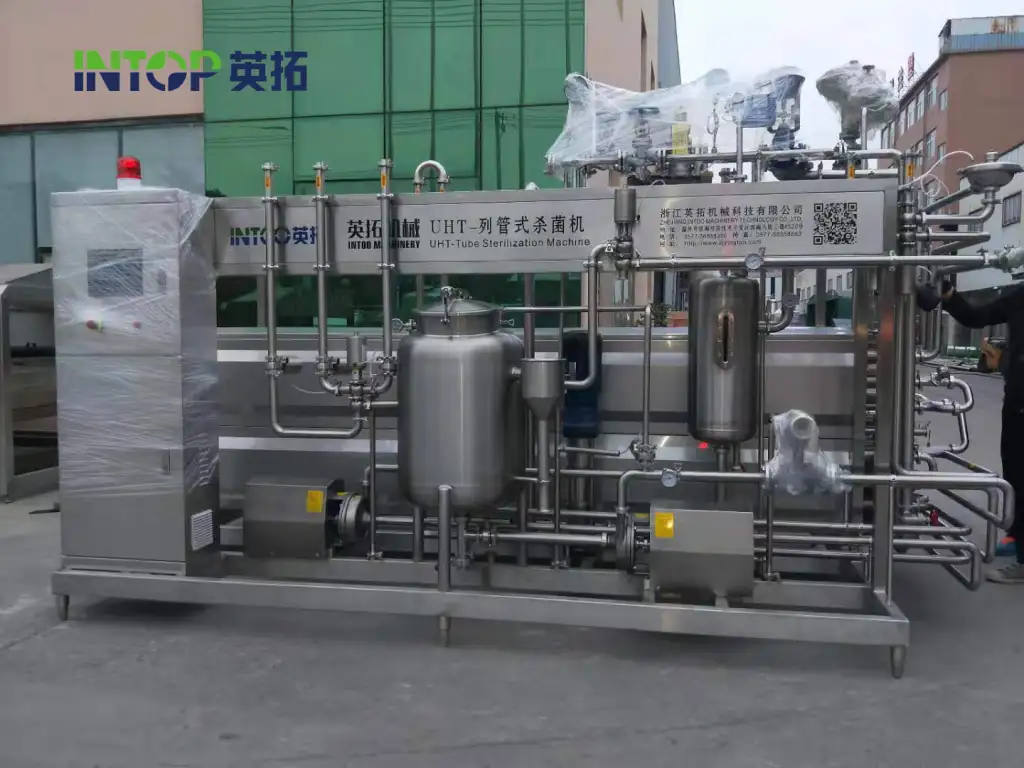
4. UHT Processor (The Core Investment)
The UHT processor is the most expensive single piece of equipment in the line. Two main technologies exist:
Direct UHT (steam infusion or steam injection):
- Heats milk by direct contact with steam for 1–3 seconds
- Produces slightly better flavor retention for sensitive products
- Requires a steam boiler and sterile condenser
- Higher operating cost due to steam generation
- Price range: $120,000–$350,000
Indirect UHT (plate or tubular heat exchanger):
- Heats milk through a plate or tube wall via hot water
- More energy efficient per liter processed
- Slightly longer exposure time required (3–5 seconds)
- More common in Chinese-manufactured lines
- Price range: $80,000–$300,000
For most commercial UHT milk lines, indirect UHT via tubular heat exchanger is the standard choice—lower capital cost, simpler operation, and adequate product quality for the vast majority of market applications.
5. Aseptic Filling Machine
The aseptic filler is where UHT lines diverge most sharply from pasteurization lines. A standard HTST filling machine costs $30,000–$80,000. An aseptic filling machine for UHT milk costs $150,000–$600,000 depending on format and speed.
Filler formats include:
- Tetra Pak-style gable-top cartons (500ml, 1L) — most common for retail, moderate cost
- SIG Combibloc cartons — similar price range to Tetra Pak
- Plastic bags in cartons (gable-top) — lower packaging material cost
- EPS cups with aluminum lids — common in food service, lower material cost but higher equipment cost for sealing
Line speed is measured in packages per hour (PPH): small-format fillers run 3,000–6,000 PPH; medium-format (1L cartons) run 6,000–12,000 PPH. Speed directly determines your effective daily throughput.
6. Aseptic Packaging Materials
This is a recurring cost that is easy to underestimate. Aseptic packaging (sterile cartons with aluminum cores) costs $0.03–$0.08 per liter, depending on format, volume, and supplier. Over a 10-year operating horizon, packaging material cost typically exceeds the initial equipment investment for the filling line.
For a 30,000 L/day UHT plant running 300 days/year:
- Annual volume: 9,000,000 liters
- Packaging material at $0.05/L: $450,000/year
- Over 10 years: $4,500,000 in packaging material vs. $400,000–$800,000 for the filling machine itself
This cost must be in your unit economics from the first financial model, not discovered after you have signed equipment contracts.
7. CIP System, Quality Control, and Utilities
Clean-In-Place (CIP) system for UHT lines must be more rigorous than for HTST lines because the aseptic circuit requires validated sterilization cycles. Plan $30,000–$80,000 for a UHT-grade CIP system. A basic quality control lab adds another $5,000–$20,000. Utility connections typically require 15–25% of total equipment cost in installation and infrastructure.
UHT Milk Processing Equipment Cost by Capacity
Here is what UHT lines actually cost in 2026, broken down by daily capacity, based on Chinese-manufactured turnkey packages:
| Capacity | Typical Configuration | Chinese Supplier (USD) | European Supplier (USD) |
|---|---|---|---|
| 5,000 L/day | Indirect UHT, semi-automatic aseptic filler, small format | $250,000 – $400,000 | $500,000 – $800,000 |
| 10,000 L/day | Indirect UHT, automatic aseptic filler, 1L format | $400,000 – $650,000 | $800,000 – $1,400,000 |
| 20,000 L/day | Indirect UHT + homogenizer, automatic aseptic filler, multi-format | $650,000 – $1,000,000 | $1,300,000 – $2,200,000 |
| 30,000 L/day | Dual UHT trains or single large, automatic high-speed aseptic filler | $900,000 – $1,400,000 | $1,800,000 – $3,000,000 |
| 50,000 L/day | Fully automatic line, multiple process trains, high-speed aseptic filler | $1,400,000 – $2,200,000 | $2,800,000 – $5,000,000 |
These prices cover equipment only—installation, civil works, utilities, and commissioning add 20–35% on top. For a turnkey project where the supplier handles installation and commissioning, expect the all-in cost to be 1.3–1.5x the equipment price quoted above.
China vs. Europe: What the Price Gap Actually Means
The 40–60% price gap between Chinese and European UHT equipment suppliers is real. Here is what you are actually comparing:
Where Chinese suppliers win:
- Capital cost is 40–60% lower for equivalent throughput specifications
- Faster delivery: 4–6 months from contract to factory acceptance vs. 8–12 months for European equivalents
- More flexible customization—Chinese manufacturers are more willing to modify standard designs for specific client requirements
- Growing food safety certification coverage—many Chinese UHT suppliers now hold CE, ISO 22000, and third-party food safety certifications
Where European suppliers win:
- Longer track record on UHT-specific process engineering
- More developed aseptic filling technology—European aseptic filler manufacturers have tighter validated sterility ranges
- Documentation quality: P&ID drawings, FAT protocols, operator training curricula are more comprehensive
- Global spare parts networks—critical for plants in Africa, Southeast Asia, and Latin America
- Remote diagnostics and PLC integration—VPN-connected monitoring for remote troubleshooting is more standard
The practical reality: For a buyer evaluating a Chinese UHT line in 2026, the process design quality varies enormously between suppliers. Request the process flow diagram and CIP validation documentation before signing. A supplier who cannot provide a detailed CIP protocol with measured rinse-water quality parameters is selling equipment, not engineering a process.
How to Reduce Your UHT Line Investment Cost
1. Buy the turnkey package, not individual machines. When you piece together a UHT line from three different suppliers, you own every interface problem. A single supplier who engineers and owns the complete system integration is worth 10–15% premium on equipment price.
2. Specify the minimum aseptic filler speed you actually need. High-speed aseptic fillers (12,000+ PPH) cost 50–100% more than medium-speed units (6,000–8,000 PPH). If your realistic market demand is 20,000 L/day, a medium-speed filler running two 8-hour shifts is sufficient.
3. Negotiate packaging material supply agreements before finalizing equipment selection. Aseptic packaging costs $400,000+ per year for a 30,000 L/day plant. Some suppliers offer 5–10% discounts when you buy equipment from them.
4. Use indirect UHT unless you have a specific product reason for direct UHT. Direct UHT costs 30–40% more for marginal quality improvement on most product types.
5. Request a pilot test before signing. A pilot-scale UHT trial costs $3,000–$8,000 and validates your process parameters before you commit to a $1 million production line.
Investment Return Considerations for UHT Lines
UHT lines are justified when at least one of three conditions applies:
- Your target market requires shelf-stable milk (export to hot-climate countries, regions without reliable cold chain)
- Your distribution radius exceeds what refrigerated shelf life can support (typically more than 500km from plant to retail)
- Your product portfolio includes extended shelf life dairy beyond just fresh milk
FAQ: UHT Milk Processing Equipment Cost
Q: What is the minimum economically viable capacity for a UHT milk line?
For most markets, minimum viable UHT capacity is 10,000 L/day. Below this threshold, fixed cost per liter makes it very difficult to compete on price with pasteurized milk. A 5,000 L/day UHT line is viable only in very specific circumstances: small island nations with no local dairy supply, premium niche products with high margin per liter, or government procurement contracts with guaranteed off-take.
Q: Can a UHT line also produce pasteurized milk?
Not simultaneously on the same process train. Switching between UHT and HTST mode requires a deep clean and sterility re-validation that takes 4–8 hours. You can configure a multi-product facility with separate process trains—one UHT, one HTST—if your volume justifies the capital cost.
Q: How long does UHT milk actually last?
Properly processed and packaged UHT milk maintains sterility for 6–9 months at ambient temperature, as long as the package remains sealed and undamaged. Once opened, it must be refrigerated and consumed within 3–5 days.
Q: What certifications does my UHT equipment need for export to the EU or US?
For EU export: CE marking, ISO 22000 or FSSC 22000 food safety certification, and EU-compliant HACCP documentation. For US FDA export: equipment must meet 21 CFR Part 110 food safety regulations and the plant needs HACCP verification.
Q: Why do aseptic packaging materials cost so much?
Aseptic packaging is a multi-layer structure—polyethylene, paperboard, and aluminum foil—with each layer serving a specific function. The aluminum core is what makes aseptic packaging different from refrigerated carton packaging. The sterile filling environment inside the aseptic filler requires inline sterilization using hydrogen peroxide before forming and filling.
Q: Should I buy a used UHT line?
Only in very specific circumstances: the line was running within the past 12 months, you have access to complete maintenance records, and you have budgeted 25–35% of the purchase price for reinstallation, replacement wear parts, and debugging. UHT lines are particularly risky as used equipment because the aseptic filling circuit integrity is very difficult to verify after the fact.
Ready to Get a UHT Equipment Quote?
UHT processing is a major capital investment where the details determine whether your plant runs profitably or becomes a liability. The equipment cost is just the starting point—process design, CIP validation, packaging material supply agreements, and post-sales technical support matter more over a 10-year operating horizon than the initial equipment price.
ISSAC INDUSTRY supplies UHT milk processing lines with transparent capacity-based pricing, complete process documentation, and on-site commissioning. Tell us your target daily capacity, product format, and market destination—we will send a detailed equipment proposal within 48 hours.
Get a free UHT equipment cost estimate → Provide your capacity requirements and preferred product format for an itemized quote tailored to your investment parameters.
Internal link: UHT Milk Processor Equipment | Aseptic Filling Machine | Complete Dairy Production Line