How to Plan a Dairy Production Line: Complete Configuration Guide 2026
Issacindustry
<!DOCTYPE html>
How to Plan a Dairy Production Line: Complete Configuration Guide 2026
A dairy production line is one of the most capital-intensive food processing investments you can make. Whether you're building a 5,000-liter-per-day pasteurized milk plant or a 50,000-liter-per-day UHT dairy facility, the decisions you make at the configuration stage determine your operating efficiency for the next 15–20 years.
Most buyers spend 3–6 months researching equipment but only 2–3 weeks on line configuration. That's backwards. The equipment is replaceable. The layout isn't.
What Is a Dairy Production Line?
A dairy production line is an integrated system of processing equipment that transforms raw milk into finished dairy products — pasteurized milk, UHT milk, yogurt, cheese, or ice cream. Each product requires a different subset of equipment, but all lines share common upstream processes: milk reception, filtration, separation, standardization, homogenization, and pasteurization.
The configuration you choose depends on three factors:
- Target product — what you're making determines the downstream equipment
- Daily capacity — influences equipment sizing and layout
- Market destination — export markets demand stricter compliance than domestic ones
Key Equipment in a Dairy Production Line
1. Milk Reception Station
Every line starts here. Raw milk arrives from farms or tanker trucks at 2–4°C and must be quickly transferred to storage silos. The reception station includes a balance tank, plate heat exchanger for pre-cooling, milk pump, and inline filter. A properly designed reception station reduces bacterial count before the milk even enters processing. Poor design means you're fighting contamination from day one.
2. Separation & Standardization
Whole milk is separated into skim milk and cream using a centrifugal separator. Standardization follows — adjusting the fat content to meet product specifications. For example, full-fat milk requires 3.2% fat, while semi-skimmed needs 1.5%. Modern separators operate at 8,000–10,000 RPM and can process 10,000–60,000 liters per hour depending on model.
3. Homogenization
Unhomogenized milk separates within hours — cream rises to the top. A homogenizer pushes milk through a fine valve at 150–250 bar, breaking fat globules from 4–5 microns down to under 1 micron. This creates a stable emulsion that stays uniformly mixed for the product's shelf life. Skipping homogenization is a false economy — it extends shelf life and improves mouthfeel significantly.
4. Heat Treatment — Pasteurization vs. UHT
This is the most critical process decision in your line configuration.
Pasteurization (72–85°C for 15–20 seconds):
- Extends refrigerated shelf life to 7–14 days
- Preserves fresh milk flavor
- Requires cold chain distribution
- Lower equipment cost
UHT Processing (137–145°C for 3–5 seconds):
- Extends shelf life to 6–9 months at ambient temperature
- Destroys all microorganisms including spores
- Enables export to distant markets without cold chain
- Requires aseptic packaging (Tetra Pak, SIG, or similar)
For export-oriented plants, UHT is the standard. For domestic fresh milk distribution with reliable refrigeration, pasteurization is sufficient.
5. Fermentation & Culturing (for Yogurt Lines)
If you're producing yogurt, fermented milk, or probiotic drinks, you need a fermentation tank with precise temperature control (40–45°C). Bulk culture tanks prepare the starter culture. Fermentation time ranges from 4–12 hours depending on product style — stirred yogurt needs 4–6 hours; set yogurt may require 8–12 hours.
6. Filling & Packaging
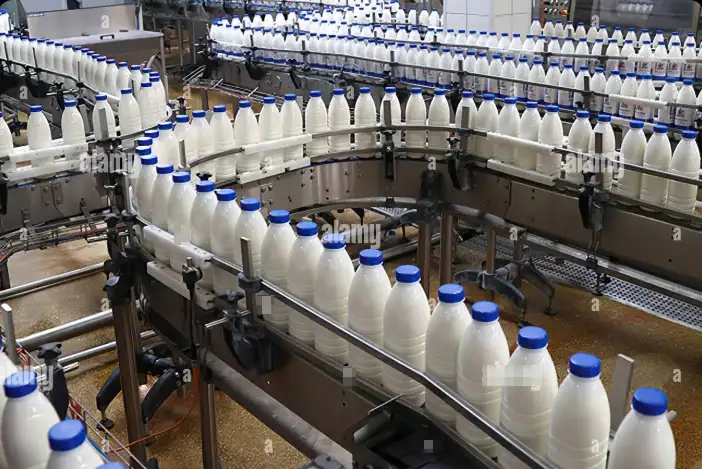
The filling machine is where line speed is determined. A typical rotary filling machine for milk cartons operates at 6,000–12,000 packages per hour. Aseptic filling lines for UHT milk run at similar speeds but require significantly more floor space and higher capital investment. For yogurt, you need either cup fillers (for set yogurt) or tubular fillers (for drinking yogurt).
Capacity Planning: Matching Equipment to Demand
Overcapacity wastes money. Undercapacity loses sales. Here's a practical framework:
Small-scale plant: 2,000–5,000 L/day
- Single-stream equipment sufficient
- Batch processing acceptable for yogurt
- Total equipment investment: USD 150,000–400,000
Medium-scale plant: 10,000–30,000 L/day
- Continuous processing line required
- Semi-automatic or fully automatic CIP systems
- Total equipment investment: USD 400,000–1,200,000
Large-scale plant: 50,000–200,000+ L/day
- Fully automatic line with central control system
- Multiple production shifts
- Total equipment investment: USD 1,500,000–5,000,000+
One common mistake: buying equipment rated for higher capacity than you actually need, then running it at 40% load. This increases energy cost per liter and accelerates wear. Size your equipment to 120% of your realistic 3-year production target.
2026 Cost Breakdown for a Dairy Production Line
Prices vary significantly by manufacturer origin, automation level, and whether you buy individual machines or a turnkey line from a single supplier. Here's what you're looking at:
- Milk reception + storage: USD 25,000–80,000
- Separation + standardization: USD 40,000–120,000
- Homogenizer: USD 30,000–90,000
- Pasteurizer / UHT processor: USD 80,000–300,000
- Fermentation tanks (for yogurt): USD 50,000–200,000
- Filling machine: USD 100,000–500,000
- Packaging materials (year 1): USD 30,000–150,000
- Utilities + installation: Typically 15–25% of equipment cost
Chinese manufacturers typically offer 30–50% lower prices than European equivalents for equivalent specifications. The trade-off is typically in software, documentation quality, and post-sales support depth. For export-market buyers, audit the manufacturer's CE compliance and food safety certifications before signing.
How to Choose a Dairy Equipment Supplier
Price matters. Service matters more. A cheap line that stops production for 2 weeks every month costs more than a premium line that runs at 98% uptime over 5 years.
Questions to ask every supplier:
- Can you provide references from plants running the same configuration for 3+ years?
- What is your CIP (Clean-In-Place) protocol, and does it meet EU/FDA standards?
- Do you offer remote diagnostic support, or must an engineer visit for every fault?
- What are your spare parts lead times? Can you ship critical parts within 48 hours?
- Do you provide process flow diagrams, P&ID drawings, and operator training materials?
- What is the scope of your installation supervision — do your engineers stay on-site until commissioning is complete?
For turnkey projects, the supplier should provide: civil work guidance, equipment installation, process commissioning, operator training, and a minimum 12-month performance warranty. If a supplier refuses to guarantee output specifications in writing, walk away.
Configuration Mistakes to Avoid
1. Not designing for product flexibility from the start.
A line configured only for UHT milk cannot easily switch to酸奶 production without significant modification. If your market might evolve — for example, adding yogurt to your portfolio — specify this upfront and configure the fermentation section accordingly.
2. Underestimating utility requirements.
A 30,000 L/day dairy plant requires: 300–500 kW of electrical power, 5–10 tons of steam per hour, 20–40 m³ of purified water per day, and compressed air at 6–8 bar. Site utility capacity is often the constraint that delays commissioning by 3–6 months.
3. Ignoring aseptic packaging cost.
UHT milk requires aseptic packaging — typically USD 0.03–0.08 per liter of finished product in packaging material cost alone. Over a 10-year horizon, packaging cost often exceeds equipment cost. Factor this into your unit economics before sizing the line.
4. Skipping pilot testing.
Before committing to full-scale production, run your formulations through a pilot-scale system. This validates process parameters, identifies formulation issues, and gives your operators hands-on experience before the real production starts.
Project Timeline: From Decision to First Production
A typical turnkey dairy plant project follows this timeline:
- Month 1–2: Site selection, feasibility study, supplier evaluation
- Month 3–4: Line configuration finalization, contract signing
- Month 5–8: Equipment manufacturing (European suppliers: 6–12 months; Chinese suppliers: 4–8 months)
- Month 9–10: Site preparation, civil works, utility installation
- Month 11–12: Equipment installation, CIP commissioning, trial production
- Month 13: First commercial batch, full operation handover
Chinese-manufactured turnkey lines typically compress this to 8–10 months total. European projects commonly extend to 14–18 months.
FAQ — Dairy Production Line Configuration
Q: What is the minimum capacity for a viable dairy plant?
A: For a commercially viable operation in most markets, minimum economical capacity is 5,000 L/day for pasteurized milk or 10,000 L/day for UHT. Below this, per-liter overhead makes profitability difficult.
Q: Can one line produce multiple dairy products?
A: Yes, with proper configuration. A flexible line with separate fermentation tanks can produce pasteurized milk on some days and yogurt on others. However, product changeovers require full CIP cycle (2–4 hours), so daily product switching is typically impractical.
Q: What certification do I need for dairy export to the EU?
A: You need CE marking on equipment, ISO 22000 food safety certification for your plant, and EU-compliant quality management documentation. Work with a recognized certification body (SGS, Bureau Veritas, TÜV) from the start.
Q: How long does a dairy production line last?
A: With proper maintenance, a well-built dairy line has a 15–20 year operational life. Wear parts (seals, plates, gaskets) require replacement every 2–5 years. Electronics and control systems typically have a 10–12 year lifecycle before modernization is needed.
Q: Should I buy a used dairy line?
A: Only if you have detailed inspection records and the line was idle for less than 12 months. Dairy lines are difficult to transport and reinstall — hidden wear issues can wipe out any purchase price savings. Budget 20–30% of the purchase price for reinstallation, replacement parts, and debugging.
Ready to Configure Your Dairy Production Line?
Whether you're planning a 10,000 L/day pasteurized milk plant or a 100,000 L/day UHT facility, ISSAC INDUSTRY provides turnkey dairy line solutions with transparent pricing, EU-compatible specifications, and on-site commissioning support.
Share your production target, preferred product mix, and market destination — we'll send you a preliminary configuration and budget estimate within 48 hours.
Contact: WhatsApp +86 173 29438411 | [email protected] | www.issacindustry.com